Europe knows how to innovate. Now it’s time to build global climate leaders.
Europe is no longer asking whether climate technologies work. Many are already proving themselves. The real question is how to scale them fast enough to transform entire industries, strengthen our competitiveness, and turn innovation into companies that lead markets.
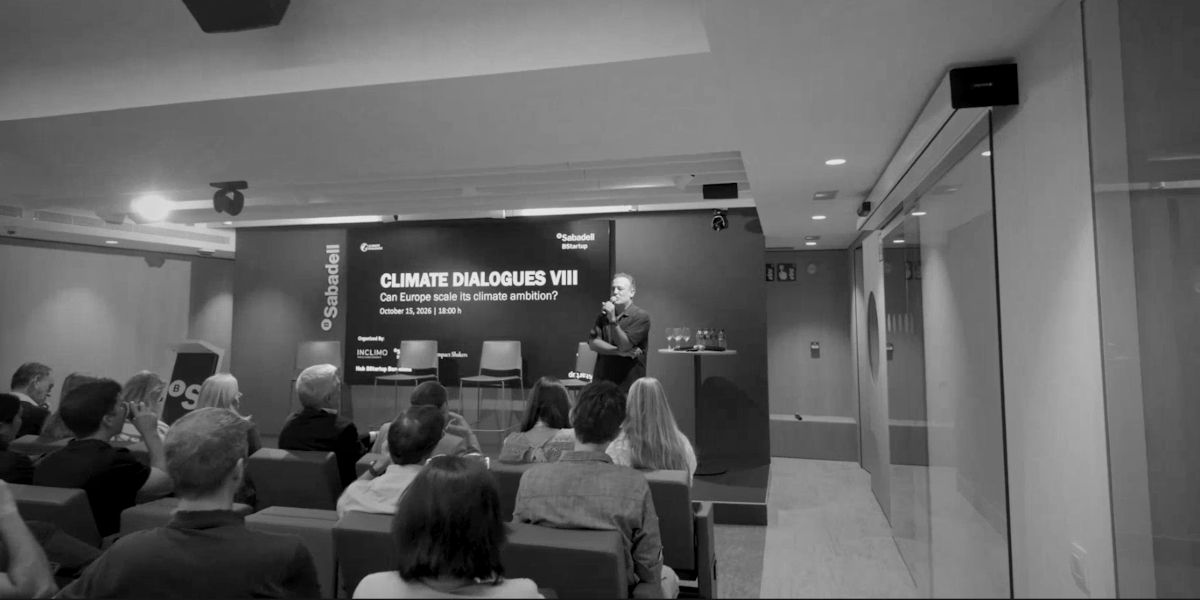
With this premise, we hosted the eighth edition of Climate Dialogues at Hub BStartup Barcelona, a series we promote together with Inclimo Climate Tech and Impact Shakers.
As part of Barcelona Impact Week, we brought together investors, founders, and experts from the European climate tech ecosystem to discuss a key question: what does it take for a promising technology to become a company capable of transforming an industry?
The conversation ranged from early-stage funding to the challenges that emerge when a startup needs to grow, industrialize, and compete on a global scale.
We discussed capital, regulation, and public-private collaboration, but also something that often goes unnoticed in the headlines: the challenge of execution, attracting talent, and building organizations ready for growth.
As Daria Saharova, Co-founder and Managing Partner at World Fund, pointed out, “building a technology and building a company capable of leading an industry are different skill sets.” Her reflection highlighted one of the biggest challenges facing the European ecosystem: moving from innovation to business leadership.
Beyond funding
One of the clearest conclusions from the session was that the challenge is not simply the availability of capital. Companies with strong value propositions continue to attract investors willing to support them. As Jahed Momand, Co-founder and General Partner at Cerulean Ventures, noted, “the best companies can still choose who they want to work with”.
This view was shared by Josep Miquel Torregrosa, Partner at Suma Capital, who highlighted that strong opportunities continue to generate intense competition among funds: “Capital is not lacking. We find ourselves competing with other funds to close the same deals. Great companies have options”.
More than a question of resource availability, the discussion pointed to another decisive factor: the ability to build exceptional companies that attract talent, customers, and investors alike.
However, a more fundamental question also emerged: are we creating enough new companies to fuel the next generation of European climate leaders? As Yonca Braeckman, Founder and CEO of Impact Shakers, explained: “Europe needs to take more risks at the early stages in order to expand the pipeline of companies with growth potential”.
A strategic opportunity for Europe
Another central topic was the role Europe can play in this new phase.
In a context defined by the energy transition, industrial decarbonization, and the need to strengthen competitiveness, climate tech represents a unique opportunity to combine economic growth with positive impact.
Participants agreed that Europe has a unique window of opportunity to build new industrial capabilities, attract investment, and strengthen its technological leadership.
This is not only about responding to the climate challenge. It is also about seizing one of the greatest economic and business opportunities of the coming decades.
The discussion also provided valuable lessons for entrepreneurs. One key takeaway was that there is no single formula for building a great company. As Heidi Lindvall, Co-founder of Pale Blue Dot, remarked, “not everyone should pursue venture capital.” A reminder that the goal is not simply to raise funding, but to build strong, sustainable businesses that create long-term value.
The challenge is no longer innovation
One message united all participants: Europe does not need to prove that it can innovate. What it needs to prove is that it can scale.
As Fernando Casado, Co-founder of Inclimo Climate Tech, concluded, Europe has already demonstrated its ability to generate innovation. The next step is to be equally ambitious in growth, industrialization, and scaling capabilities.
Because the climate transition no longer depends solely on developing new technologies. It depends on our ability to turn them into strong, scalable companies with a real impact on the economy.
If you would like to explore the ideas discussed during the session in greater depth and hear first-hand insights from some of the sector’s leading investors and entrepreneurs, we invite you to watch the full session here.